
Peptide research has one huge problem. There are simply too many possible peptide sequences to test one by one. That’s where AI changes the game.
AI helps researchers learn from old peptide data and quickly predict which sequences may work better. Instead of wasting time on random trials, labs can focus on stronger candidates early.
But the real breakthrough is not speed alone. It’s smarter discovery. And as exciting as this sounds, the final proof still belongs to the lab because AI simply helps scientists reach the lab stage with better options.
Part 1. What AI-Designed Peptides Actually Are?
AI-designed peptides are peptides whose sequences are created or improved using Artificial Intelligence.
A peptide is a short chain of amino acids, and our body uses it in many ways. Some act as messengers, and some influence healing signals. Others affect immune responses or are being studied as possible future drugs.
Now, here’s what makes AI-designed peptides special:
Instead of scientists testing thousands of random peptide sequences in the lab, AI helps predict the best sequences first. That means researchers can move faster and focus on the strongest candidates early.
AI is not “inventing magic peptides,” rather, it is doing something smarter, like
- learning patterns from existing peptide research
- predicting which peptide sequence may work
- suggesting new options for scientists to test in real labs
Want to explore peptides used in modern lab research? Scroll down for research-based examples.
Part 2. How AI Designs Peptides (Simple 3-Step Process)
AI peptide design may sound complex, but the idea is actually easy. Think of it like this:
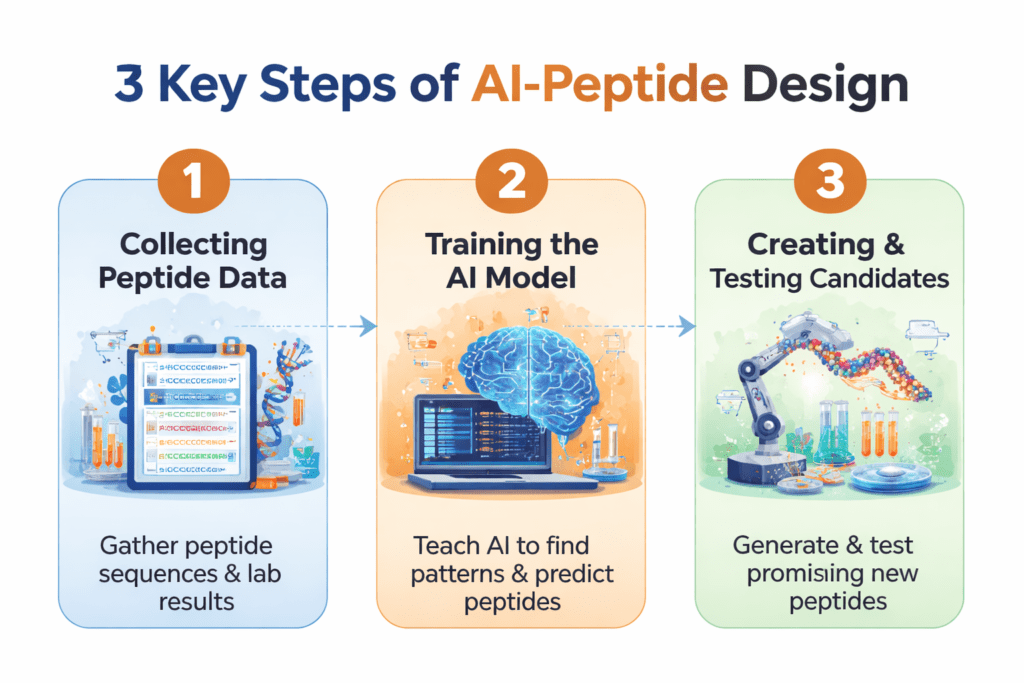
AI learns from old peptide data, then suggests new peptide sequences that may work better.
Below is the step-by-step process used by modern research teams.
Step 1: Collecting Peptide Data
AI cannot design peptides independently. First, it needs real research data to learn from.
Scientists feed AI with different types of peptide information, such as:
- known peptide sequences and amino acid patterns
- lab results showing what worked and what failed
- receptor binding data (how strongly a peptide attaches)
- toxicity and safety signals seen in experiments
- peptide stability (how fast it breaks down over time)
The bigger and cleaner the dataset is, the stronger the AI becomes. Just like humans, AI improves through learning and repeated exposure.
Once the data is collected, the next step is to train the AI.
Step 2: Training the AI Model
During training, machine learning and deep learning models search for hidden patterns that humans may not notice. This helps the AI understand what makes a peptide successful or ineffective.
It learns things like:
- Which peptide structures are linked to strong biological activity
- which sequences look promising but may be unstable
- which patterns often lead to toxicity or poor performance
- What features usually appear in high-quality peptide candidates
Instead of relying on guesses, researchers use AI to make data-based predictions. This makes peptide discovery smarter, faster, and more targeted.
Step 3: Creating and Testing New Peptide Candidates
The AI can guide scientists, but it cannot prove results. After training, the AI is ready to suggest new peptide candidates. It usually works in two powerful ways:
- Prediction: choosing top candidates from massive peptide libraries
- Generation: creating new sequences that have not been tested before
This is where the real excitement begins. But one key point always stays true:
AI does not replace the lab.
Researchers still synthesize these peptides and test them under controlled conditions. Only lab validation confirms whether a peptide is truly effective.
For validated studies, researchers often use lab-tested peptides from trusted suppliers like NuScience Peptides.
Part 3. Main Areas Where AI-Designed Peptides Are Making Big Progress
AI-designed peptides are exciting because they can improve research in areas that matter a lot in health science.
To keep this section strong and credible, we will focus on only the areas where scientific research is actively growing.
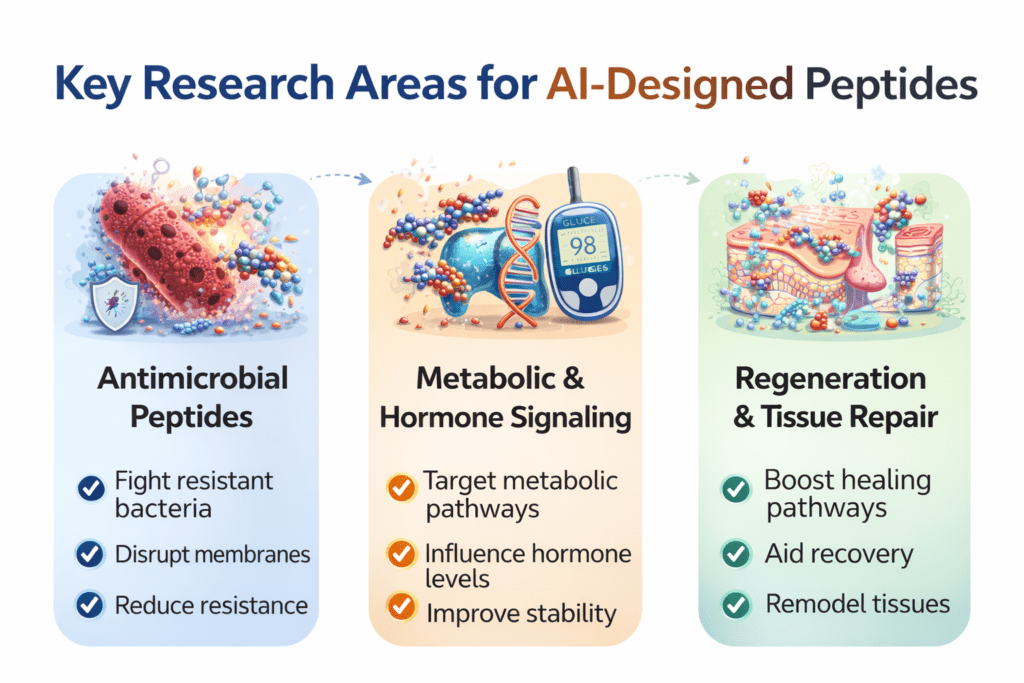
1) Antimicrobial Peptides (Fighting Resistant Bacteria)
Antibiotic resistance is one of the biggest global health threats today. The World Health Organization (WHO) has repeatedly warned that antimicrobial resistance is a growing global danger.
Some bacteria no longer respond to common antibiotics. That makes infections harder to treat. This is where antimicrobial peptides (AMPs) matter.
These peptides are studied because they can:
- disrupt bacterial membranes
- work differently from regular antibiotics
- reduce chances of resistance
Now add AI to this field, and it becomes even more powerful. AI helps researchers:
- Predict which peptides can kill bacteria
- remove toxic designs early
- explore millions of sequences quickly
This field is considered a serious future direction in medical science. Explore research peptides at NuScience Peptides.
2) Metabolic and Hormone Signaling Research
Metabolic health is one of the hottest areas in medicine today. Peptides that influence appetite, blood sugar pathways, and metabolism are widely researched. Scientists are especially interested in peptide hormones that act on multiple systems.
AI helps metabolic peptide research by:
- improving binding prediction
- optimizing sequences for stability
- helping design “better versions” faster
This is not about hype. It is about faster research.
3) Regeneration and Tissue Repair Research
Many peptides are being studied for their roles in injury recovery, regeneration pathways, and cell repair communication.
AI supports this area by helping researchers design peptides that:
- target specific receptors
- reduce unwanted effects
- remain stable longer
This is especially interesting for future research into healing-focused peptides.
Part 4. Key Benefits of AI-Designed Peptides
AI-designed peptides are not popular just because they are trendy. They matter because they solve real research problems.
Below are the most important benefits, and each one can be its own “featured highlight” in your article.
Benefit 1: Faster Discovery (Less Waiting, More Progress)
Traditional peptide discovery can take a long time. Scientists may spend months or even years testing thousands of peptide sequences before finding good candidates.
AI changes this by:
- quickly filtering weak candidates
- selecting the best sequences early
- saving huge time in the early research stages
It feels like switching from walking to driving.
Benefit 2: Smarter Screening (Testing Millions in Silico)
The number of possible peptide sequences is massive. Humans cannot test that many options manually.
AI can:
- Scan millions of peptide designs virtually
- Rank candidates by predicted performance
- reduce lab workload
This is one of the biggest reasons AI is now central to peptide science. This also explains why peptide research tools are evolving quickly across multiple health areas.
Benefit 3: Better Optimization (Designing Peptides with Goals)
AI doesn’t just find peptides, but it can also improve them. Researchers can ask AI to design peptides that balance goals like:
- higher activity
- more stability
- better selectivity
- lower toxicity risk
This makes peptide design feel more like engineering and less like gambling.
Benefit 4: Lower Costs in Early Research
As we know, lab experiments cost a lot of money. AI does not make research “cheap,” but it helps labs spend money wisely. It helps in testing fewer weak candidates, which means:
- fewer materials wasted
- fewer lab hours lost
- Research budgets are used more efficiently.
Explore Lab-Tested Research Peptides
AI helps researchers discover candidates faster, but lab-grade peptides are still needed for validation and study. Explore research peptide options at NuScience Peptides (research use only).
Part 5. Current Limitations and Challenges
AI has changed peptide research in powerful ways, but it is not a perfect solution. Major scientific reviews also highlight that AI models still require real-world validation and robust datasets.
Below are the most significant challenges scientists face when using AI in peptide design.
Challenge 1: AI Depends on Data Quality
AI works like a student. It learns from what you give it. So if the data is weak, the AI will also produce weak results.
This happens when the training data is:
- Limited (too small to learn properly)
- biased (only includes certain peptide types)
- incomplete (missing key testing details)
- incorrect (wrong labels or poor-quality results)
That is why researchers focus heavily on building clean, high-quality datasets before trusting AI outcomes.
Challenge 2: Real Biology Is Hard to Predict
A peptide can look perfect in a computer model. But the human body is not a simple system; it is complex and unpredictable. In real biological conditions, many factors can change how a peptide behaves, such as:
- Enzymes in the blood that may break peptides down quickly
- Immune reactions that may reject or neutralize certain sequences
- metabolism differences across tissues
- Unwanted off-target interactions can reduce effectiveness
So even if AI predicts success, it is still only a prediction. That is why lab validation is always required to confirm real performance.
Challenge 3: Safety and Regulation Take Time
Even when AI designs a peptide that appears promising, it still requires rigorous validation before it can be trusted in advanced research or clinical applications.
A peptide must go through:
- Strict safety testing
- controlled lab and preclinical studies
- deep investigation of side effects and risk signals
- strong validation by experts
Conclusion
AI-designed peptides are driving a smarter, faster era in peptide research. Scientists can now use AI to learn from existing research data and predict which sequences may work best. This is done through a simple process: collecting peptide data, training the AI model, and testing new peptide candidates in the lab.
AI-designed peptides have made progress in areas such as antimicrobial peptides, metabolic signaling research, and regenerative medicine studies. At the same time, this field has limits. That is why one key point always stays true: AI does not replace the lab.
In short, the future is AI-guided, but lab-tested peptides still matter; that’s where NuScience Peptides fits in.