Dermatologists report that most adults shed 50 to 100 hairs a day. The real trouble starts when follicles stop replacing those lost strands, and early thinning quietly begins.
Losing hair is normal. Losing the ability to replace it is not. Hair growth can improve when three key systems work together: blood flow, follicle repair, and inflammation control. Many people don’t notice this until their hair starts thinning.
This guide breaks down how three well-known peptides are being explored for follicle repair, blood flow, and tissue support.
Now, let’s look at the peptides most studied for healthy and stronger hair.
Part 1. Why Hair Starts to Thin
Hair grows from tiny structures called follicles. These follicles need oxygen, nutrients, and a calm environment to stay active. When blood flow slows, inflammation rises, or tissue becomes weak, hair loses support.
You may not feel these changes. They happen quietly. You only see the result later: more strands on the pillow, a wider parting, or a thinner ponytail.
Understanding what affects the follicle helps you understand why peptides have become such a popular topic. They do not “grow hair” by magic. Instead, research focuses on how they may support the systems your hair already depends on.
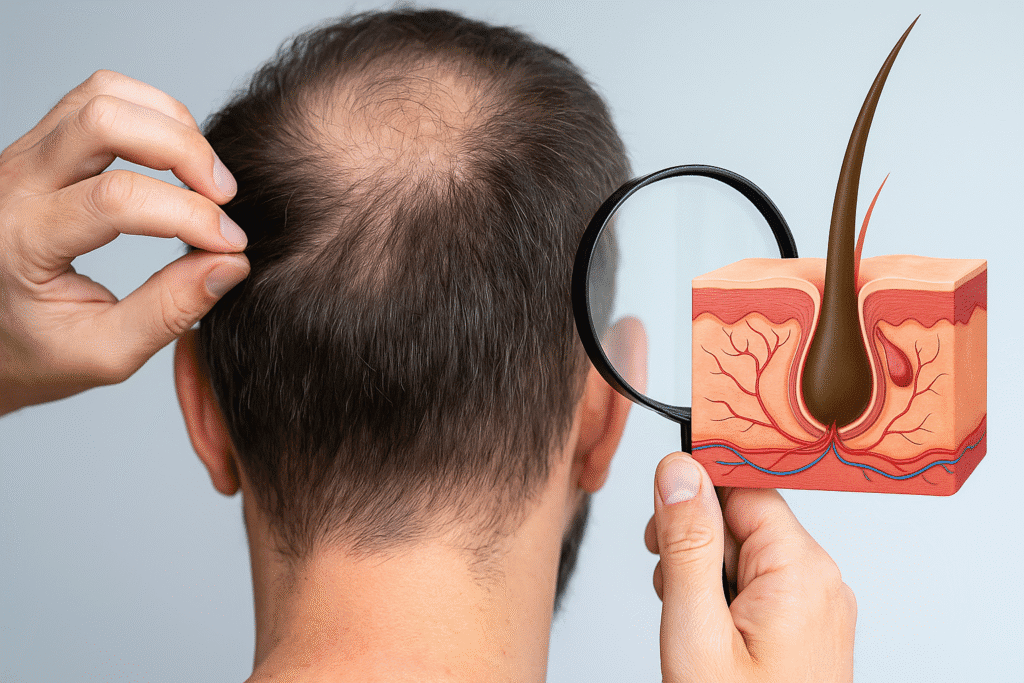
Alt Text: Man with thinning hair and a magnified view of a hair follicle.
Part 2. Best Peptides for Hair Growth Support
Researchers are paying close attention to a few peptides that may support scalp health, follicle strength, and tissue repair. Here are the three most talked-about options.
a. GHK-Cu: The Top Hair-Support Peptide
GHK-Cu is the star of hair-related peptide discussions. It is known for helping the skin recover and may support hair follicles in several ways.
Why it matters for hair:
- Helps improve blood flow near the follicle
- Supports collagen and tissue repair
- May calm scalp inflammation
- Encourages a healthy growth cycle
GHK-Cu is one of the easiest peptides to introduce to readers because both PeptideMania and NuScience Peptides have strong resources about it.
NuScience Peptides also offers GHK-Cu peptide and GHK-Cu serum for research purposes, which many people explore when learning about scalp-related studies.

Alt Text: GHK-cu Peptide from NuScience Peptides
b. BPC-157: Support for Scalp Repair
BPC-157 is widely known for its research use in healing and inflammation control. What people often forget is that the scalp is skin, and healthy skin helps healthy hair.
Why it matters for hair:
- May support tissue repair
- Helps blood vessels function better
- May calm scalp irritation
- Supports healthier skin beneath the follicle
People with stress-related hair issues or sensitivity often take an interest in BPC-157 because of its potential healing properties.
PeptideMania has deep guides on BPC-157 that explain these ideas in simple words. NuScience Peptides sells BPC-157 for research if readers want to explore further.
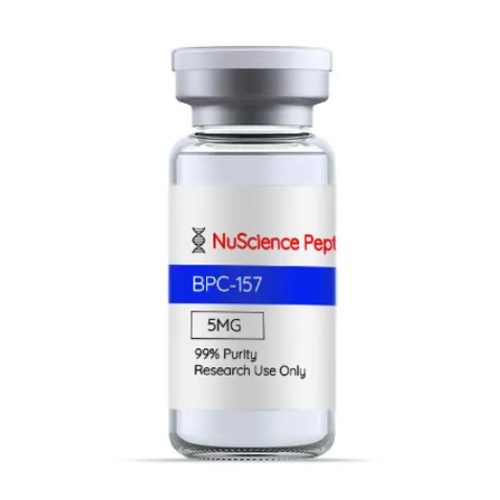
Alt Text: BPC-157 Peptide from NuScience Peptides
c. TB-500: Tissue Support for Weak Follicles
TB-500 (Thymosin Beta-4) is another peptide linked to recovery. It is often explored for its role in cell movement, tissue repair, and inflammation support.
Why it matters for hair:
- Helps support soft-tissue repair
- May reduce irritation
- Encourages cell activity around follicles
- Often paired with BPC-157 in research discussions
Hair follicles rely on the strength of the surrounding tissue. TB-500’s potential in tissue support makes it a natural part of hair-health conversations.
NuScience Peptides also carries TB-500 and even a blend of BPC-157 and TB-500 for research, which often catches the interest of users who read your educational content.

Alt Text: TB-500 Peptide from NuScience Peptides
Part 3. What You Should Know Before Exploring Peptides
Peptides sound exciting, but it’s important to understand what they are and what they are not.
- They are not treatments.
- They are not cures.
- They are not approved for human use.
Peptides like GHK-Cu, BPC-157, and TB-500 are sold for research only. The FDA has not approved them for medical use. Research is ongoing, and long-term effects are still being studied.
Hair loss also has many causes:
- Hormones
- Stress
- Genetics
- Nutrition
- Health conditions
If someone is losing hair rapidly, it is always best to speak with a dermatologist or doctor. Understanding the real cause is the first step toward the right solution.
Final Thoughts
Hair growth depends on a calm scalp, strong follicles, and healthy tissue. The peptides for hair growth discussed here, including GHK-Cu, BPC-157, and TB-500, are being explored for these same systems. They are not guaranteed solutions, but they are interesting compounds for research and education.
If readers want to explore more science, PeptideMania has full guides for each peptide written in simple language. For research-grade peptides, NuScience Peptides offers high-purity options for laboratory use.